
MEaSUREs Greenland Monthly Ice Sheet Velocity Mosaics from SAR and Landsat, Version 3
Data set id:
NSIDC-0731
DOI: 10.5067/YDLH5QG02XKC
There is a more recent version of these data.
Version Summary
Version Summary
Version changes include:
Reprocessed with a corrected DEM
Cloud optimized GeoTIFF created with GDAL 3.2.1
Reprocessed with a corrected DEM
Cloud optimized GeoTIFF created with GDAL 3.2.1
Overview
This data set, part of the NASA Making Earth System Data Records for Use in Research Environments (MEaSUREs) Program, contains monthly ice velocity mosaics for the Greenland Ice Sheet derived from Synthetic Aperture Radar (SAR) data obtained by the German Aerospace Center's (DLR) TerraSAR-X/TanDEM-X (TSX/TDX), the European Space Agency's (ESA) Copernicus Sentinel-1A and -1B satellites, and from US Geological Survey (USGS) Landsat 8 optical imagery.
See Greenland Ice Mapping Project (GrIMP) for related data.
Parameter(s):
ICE VELOCITY
Platform(s):
LANDSAT-8
Sentinel-1A
Sentinel-1B
TDX
TSX
Sensor(s):
C-SAR
OLI
SAR
Data Format(s):
GeoTIFF
JPEG
Shapefile
Temporal Coverage:
- 1 December 2014 to 7 September 2022
Temporal Resolution:
- 1 month
Spatial Resolution:
- 200 m
- 200 m
Spatial Reference System(s):
- WGS 84 / NSIDC Sea Ice Polar Stereographic NorthEPSG:3413
Spatial Coverage:
- N:83S:60E:-14W:-75
Blue outlined yellow areas on the map below indicate the spatial coverage for this data set.
Data Access & Tools
Sample Data Image
Image
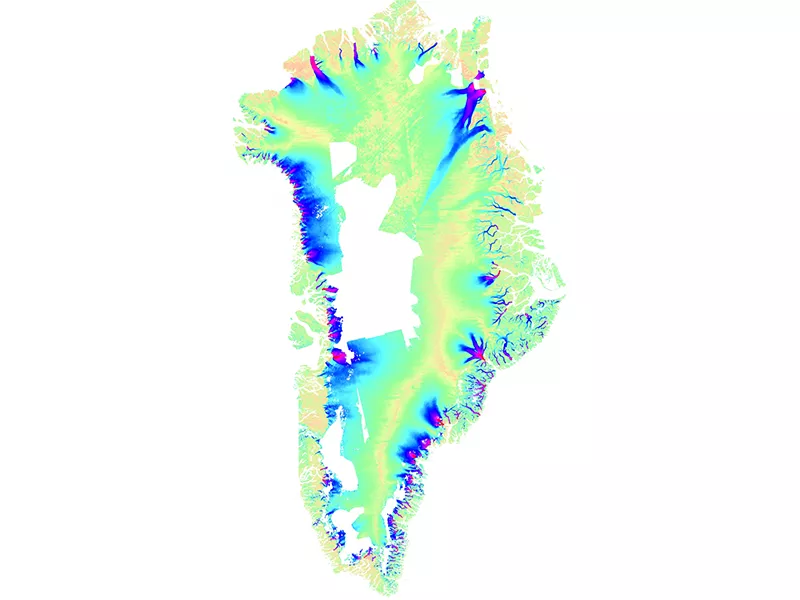
This color-coded map shows a monthly ice velocity mosaic for the Greenland Ice Sheet. Highest velocities appear in magenta and red, intermediate velocities appear in blue and green, and lowest velocities appear in yellow and peach. White patches indicate no data. Credit: NASA MEaSUREs GrIMP Data: DLR, ESA, USGS
Documentation
Help Articles
General Questions & FAQs
This article covers frequently asked questions about the NASA NSIDC DAAC's Earthdata cloud migration project and what it means to data users.
The NASA National Snow and Ice Data Center Distributed Active Archive Center (NSIDC DAAC) is migrating its primary data access from its legacy, on-premises archive to the NASA Earthdata Cloud.
How to Articles
This article shows how to download NSIDC DAAC data from NASA Earthdata Cloud to your computer using three tools: wget and curl—popular command-line utilities for downloading files—and Data Downloader, a Python-based command-line tool developed by the Physical Oceanography Distributed Active Archi
Below the image in this article, you will find sample code in IDL, MATLAB, and Python to read in a GeoTIFF file, extract the metadata, and create an image.
The code has been tested with the following data products:
We recommend using the Geospatial Data Abstraction Library (GDAL) to convert GeoTIFF files into a different format.
We recommend using the Geospatial Data Abstraction Library (GDAL) or a GIS to reproject geoTIFF files.
There are external Jupyter notebooks available that can be used to search for GrIMP products and incorporate them into a new QGIS project:
The NASA Earthdata Cloud is the NASA cloud-based archive of Earth observations. It is hosted by Amazon Web Services (AWS). Learn how to find and access NSIDC DAAC data directly in the cloud.