May 2026 snow summary
- Snow-covered area across the western United States was 49 percent of average for May, ranking last in the 26-year satellite record.
- Snow albedo, also known as snow brightness, moderated by snow age and dust, was close to average at the start of the month and dropped below the twenty-fifth percentile by May 31.
- Snow cover duration was 35 percent of average at the end of the month.
- Snow water equivalent (SWE) remained well below average in most states during May.
Overview of conditions
Snow covered area in May across the western United States was 49 percent of average, at 56,000 square kilometers (22,000 square miles) of snow cover, ranking last in the 26-year satellite record (Table 1). Snow covered area was 182,000 square kilometers (70,000 square miles) below 2011, the highest year, and 6,000 square kilometers (2,000 square miles) below 2015, the second lowest May on record.
Table 1. May 2026 Snow Cover in the Western United States (Relative to the 26-Year Satellite Record)
| Snow-Covered Area | Square Kilometers | Square Miles | Rank |
|---|---|---|---|
May 2026, Lowest | 56,000 | 22,000 | 26 |
2001 to 2025, Average | 115,000 | 44,000 | -- |
2011, Highest | 238,000 | 92,000 | 1 |
2025, Last year | 82,000 | 32,000 | 21 |
2015, Previous lowest | 62,000 | 24,000 | 25 |
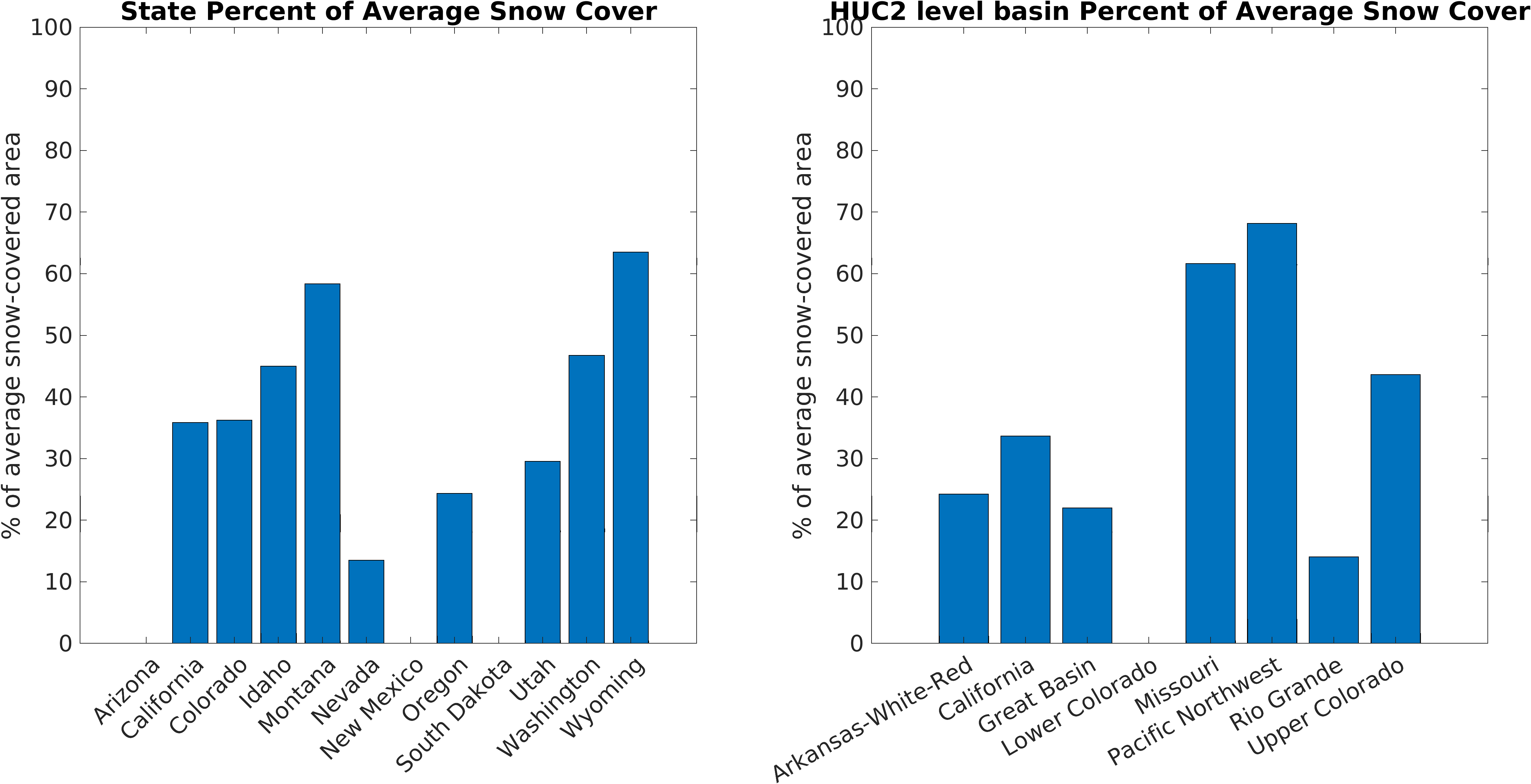
Snow cover was below average in all western states in May, although some states did see increases relative to average compared to April (Figure 1, left). For the first time this year, Wyoming had the highest snow cover relative to average (63 percent of average) after significant snowfall in the third week of May. Montana had the next highest snow-covered area relative to average at 58 percent. The Pacific Northwest states of Washington and Idaho followed, with 47 and 45 percent of average snow cover, respectively. Despite snowstorms early in the month in Colorado and late in the month in California, snow cover was only 36 percent of average in both states. The situation was worse in Utah (30 percent of average), Oregon (24 percent of average), and Nevada (13 percent of average). Almost no snow was present in Arizona, New Mexico, and South Dakota.
At the basin level, all HUC2 river basins also had below average snow cover. The Pacific Northwest (68 percent of average) and Missouri (62 percent of average) basins had the highest snow cover, while all other basins had below 50 percent of average snow cover. The Upper Colorado and California basins had 44 and 34 percent of average snow cover, respectively, followed by the Arkansas-White-Red (24 percent of average) and Great Basin (22 percent of average). Snow cover in the Rio Grande basin was only 14 percent of average, and no snow was present in the Lower Colorado basin.
Conditions in context: Snow cover
Snow-covered area remained below average during the entire month of May, but conditions relative to average did slightly improve over the month (Figure 2, upper left). On May 1, snow cover started at 49 percent of average and improved to 80 percent by May 31, despite a decline in absolute snow-covered area. Compared to the 26-year average, the snowpack in May 2026 melted at a slower rate. Snow cover was below average in most mountainous areas in May (Figure 2, upper right). However, most regions had 0 to 20 percent below average snow cover, an improvement from April. Only very limited areas experienced above average snow cover, including parts of central Wyoming, southwest Montana, and parts of Colorado’s front range.
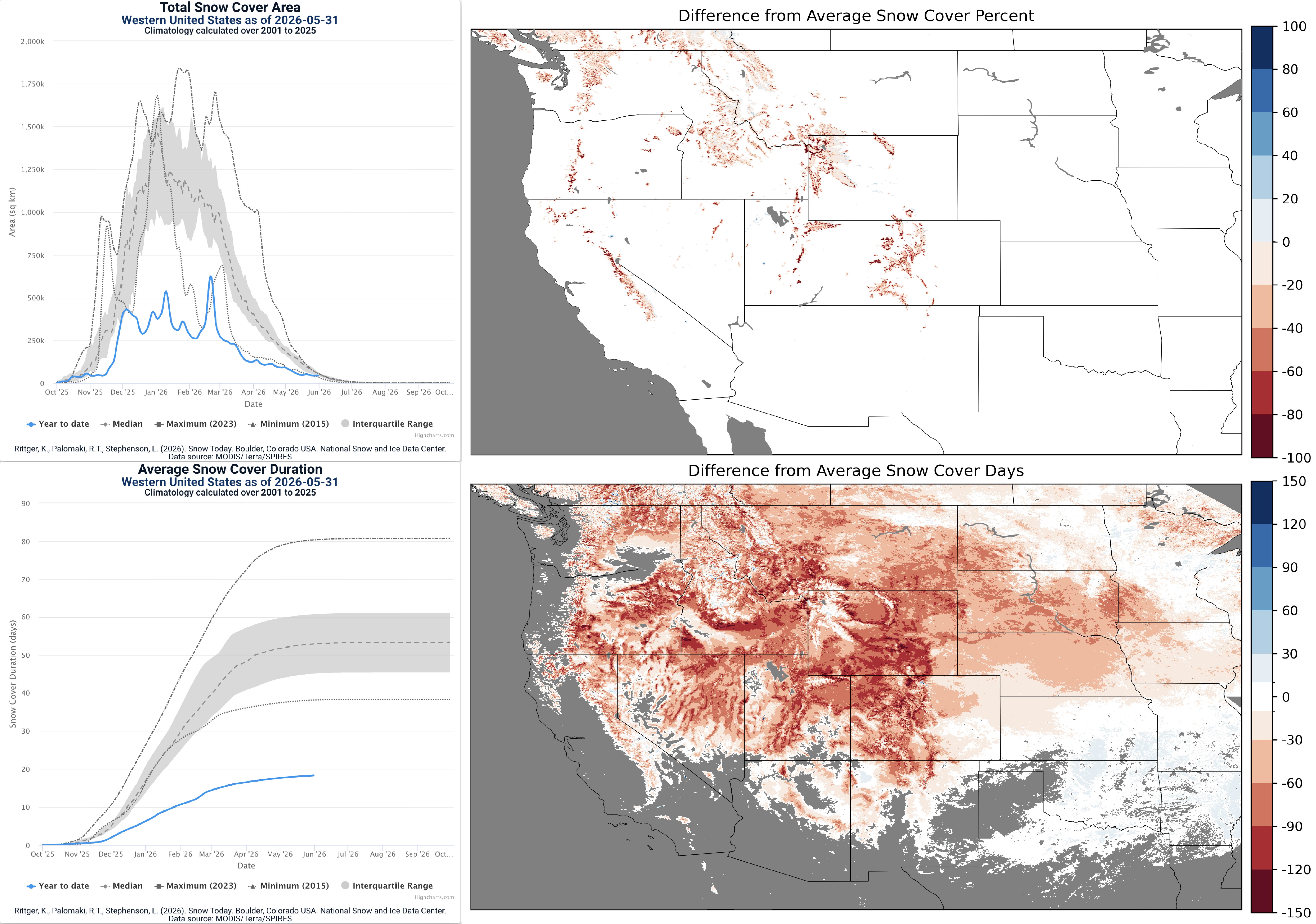
Snow cover duration, measured in days summed from October 1, 2025, to May 31, 2026, barely changed during the month (Figure 2, lower left). Snow cover duration was roughly 34 percent of average at both the beginning and the end of the month. As snow cover is accumulated over the full season since October, the spatial distribution of snow cover duration was similar to April, with most of the western states having far below average snow-covered days (Figure 2, lower right). Colorado, Wyoming, Utah, Idaho, and Oregon had large areas of 90 to 150 fewer snow-covered days than average. Small parts of Colorado, Wyoming, Montana, Idaho, Washington, and California had 10 to 60 more snow covered days than average.
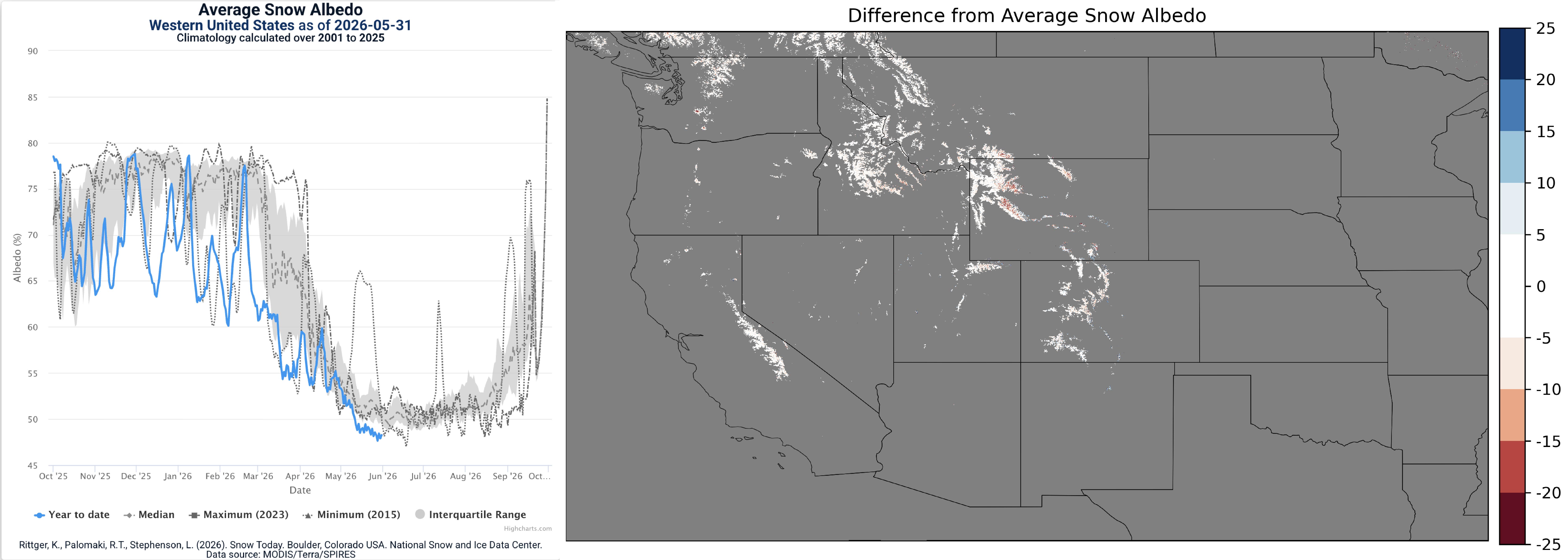
Average snow brightness, known as snow albedo, was close to average for the first week of May, then steeply declined and remained below the twenty-fifth percentile for the remainder of the month (Figure 3, left). Despite low values when averaged across the western United States, in most areas, albedo was within five percentage points of average (Figure 3, right). The most noticeable departure from average was in western Wyoming, where albedo values were 15 to 25 percent below average.
Conditions in context: Snow water equivalent (SWE)
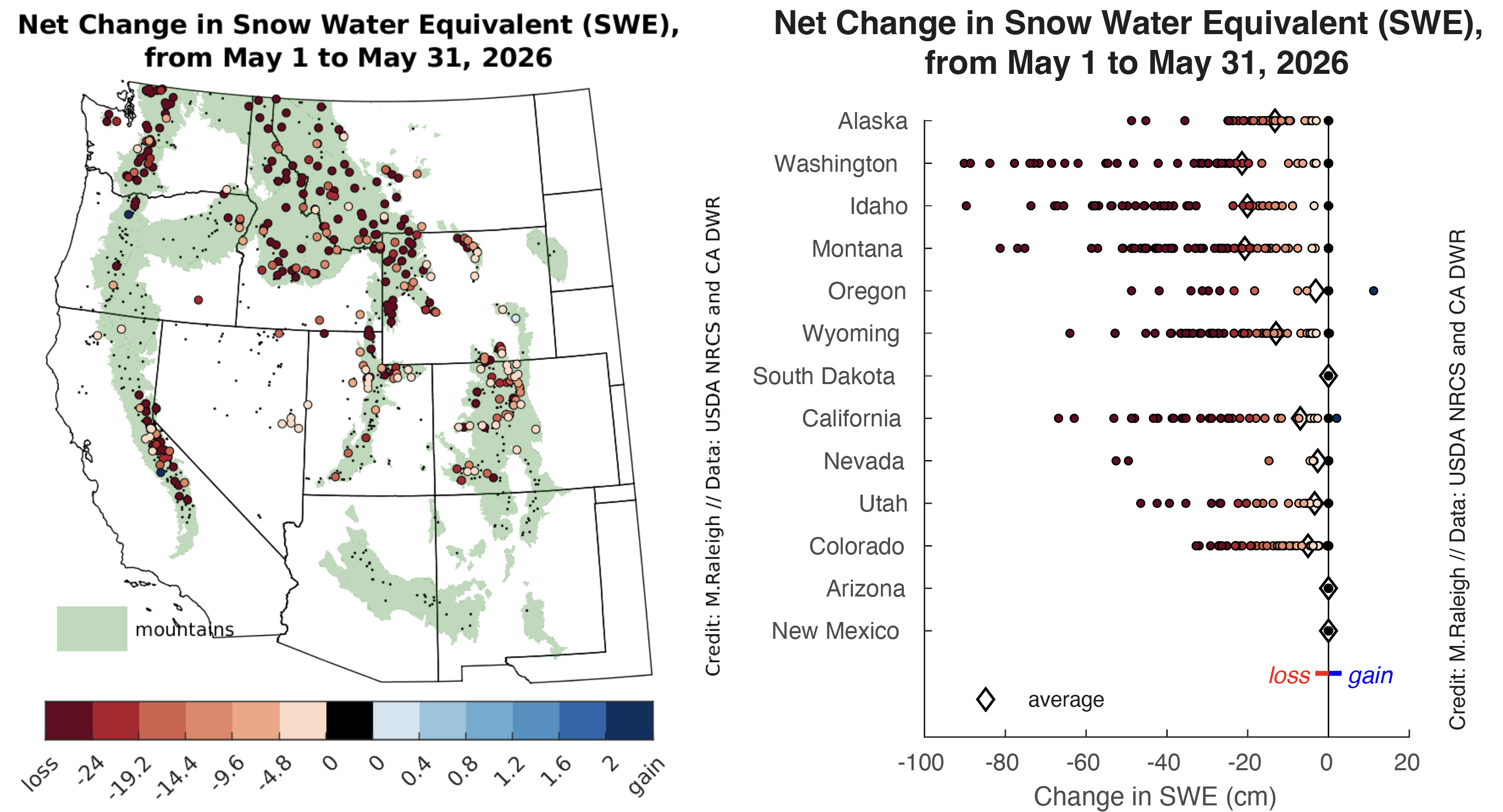
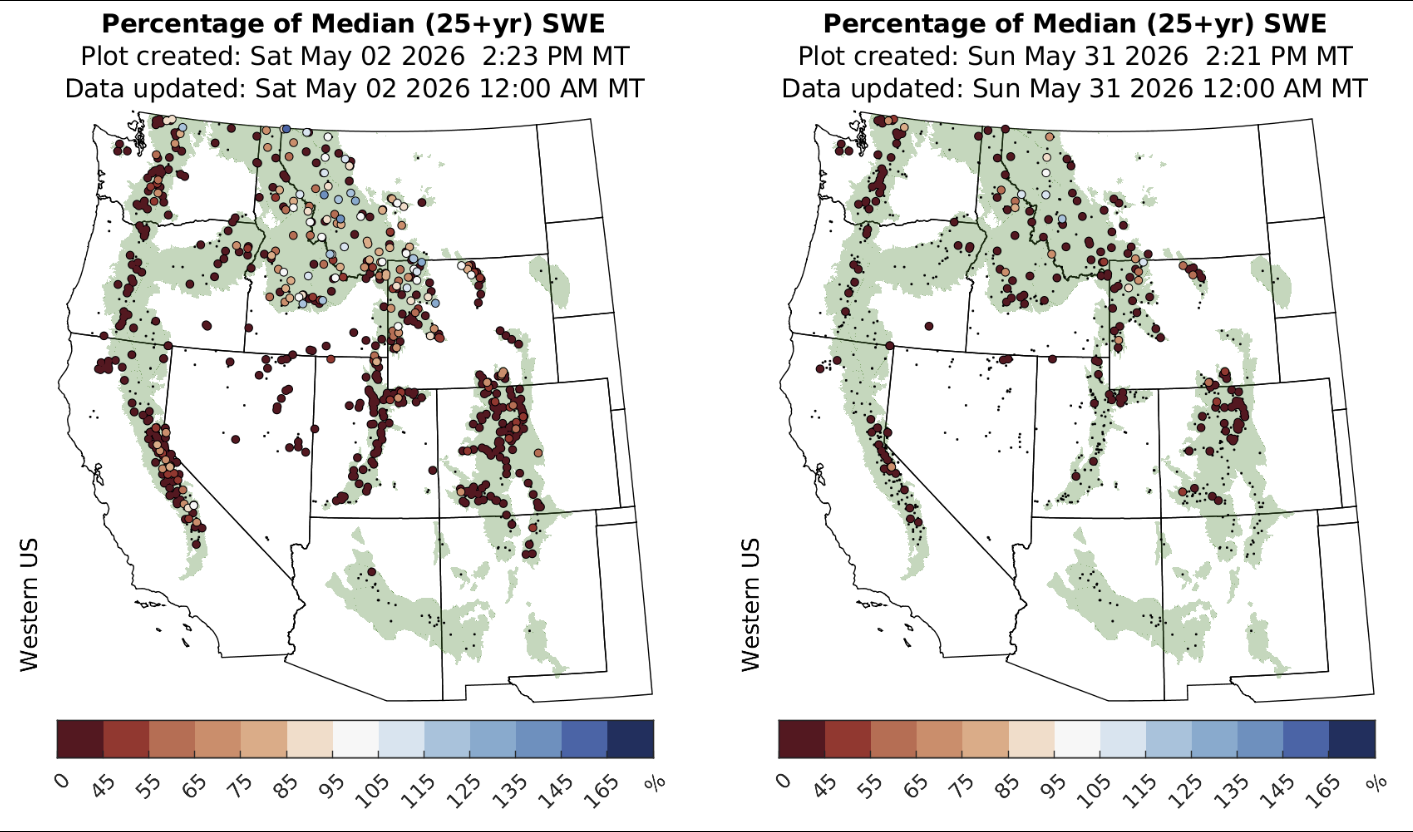
Snow water equivalent (SWE) was far below average across most of the region at the beginning of May (Figure 4, left). In most of Oregon, Washington, California, Nevada, Utah, Arizona, Colorado, and New Mexico, SWE was between 0 and 45 percent of average. Only Idaho, Montana, and Wyoming had a significant number of sites with above average SWE. At the end of the month, only five sites with above average SWE remained: one in Idaho, one in Wyoming, and three in Montana (Figure 4, right).
From May 1 to May 31, SWE increased at only three stations: one in California, one in Oregon, and one in Wyoming (Figure 5, left). All other sites had decreased SWE, with Washington, Idaho, Montana, Wyoming, and California experiencing the largest decreases. Washington, Idaho, and Montana all had an average decrease of roughly 20 centimeters (8 inches) of SWE with individual station decreases of up to 90 centimeters (35 inches). Wyoming had an average decrease of roughly 10 centimeters (4 inches) of SWE and California lost 5 centimeters (2 inches). SWE in Oregon, Nevada, and Utah also decreased, while South Dakota, Arizona, and New Mexico had no measurable SWE at both the beginning and end of the month.