March 2026 snow summary
- Snow-covered area averaged across the western United States was 34 percent of average for March, ranking last in the 26-year satellite record.
- Snow albedo, also known as snow brightness, moderated by snow age and dust contamination, peaked on March 15, then steeply declined.
- Snow cover duration was 35 percent of average at the end of the month.
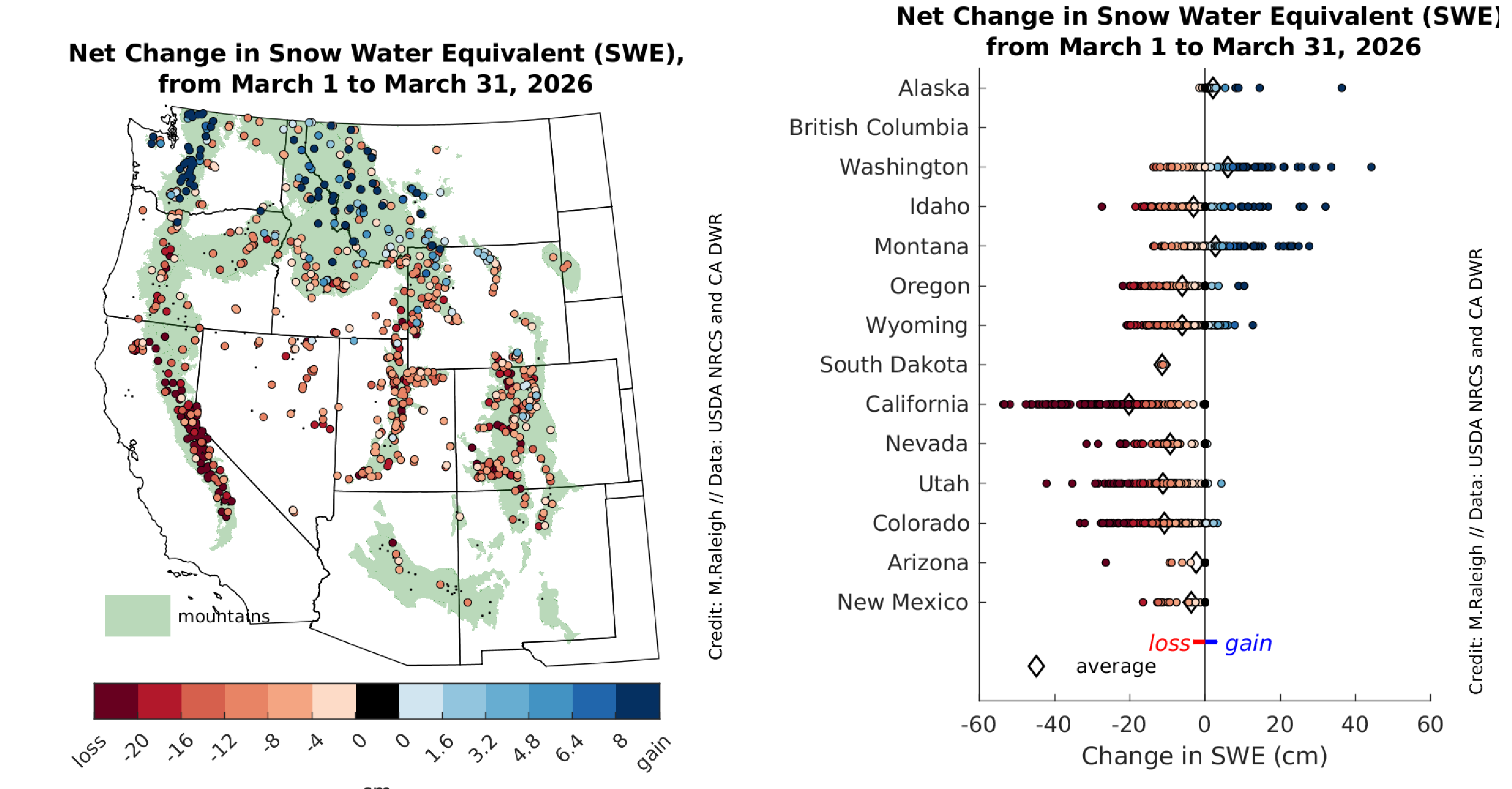
- Snow water equivalent (SWE) decreased across all western states except Montana and Washington.
Added Regions to Snow Today
Snow Today has expanded the spatial extent from the western US and New Zealand to now include US Alaska and four Canadian provinces: Yukon, Northwest Territories, British Columbia, and Alberta, with automated analysis in these regions as well as their river basins (Figure 1). With low sun angles that cause polar night in the most northern regions, data and analysis is currently limited to March 1 onward. Our monthly reports will continue to focus on the western United States and may include conditions in Alaska moving forward.
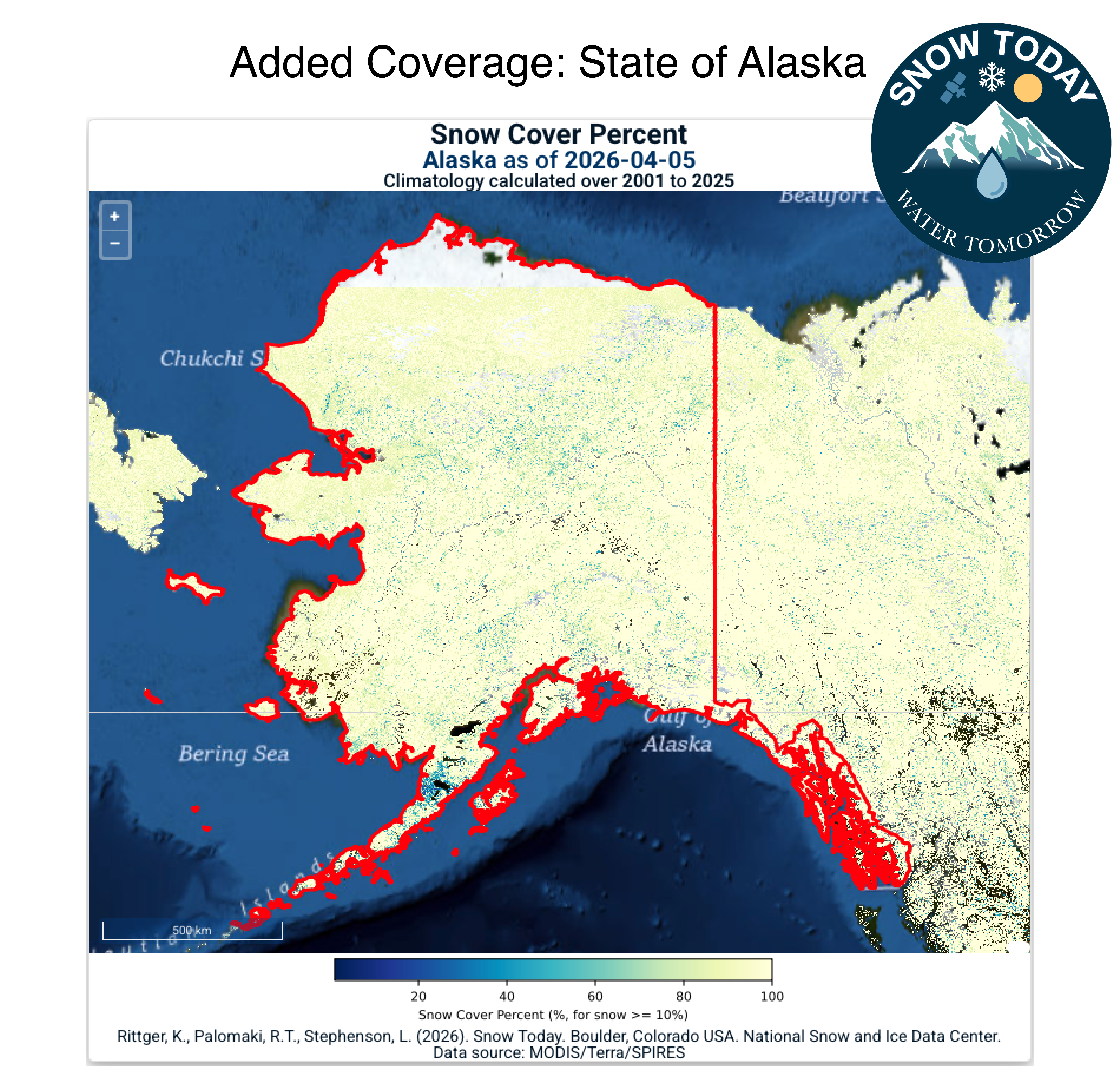
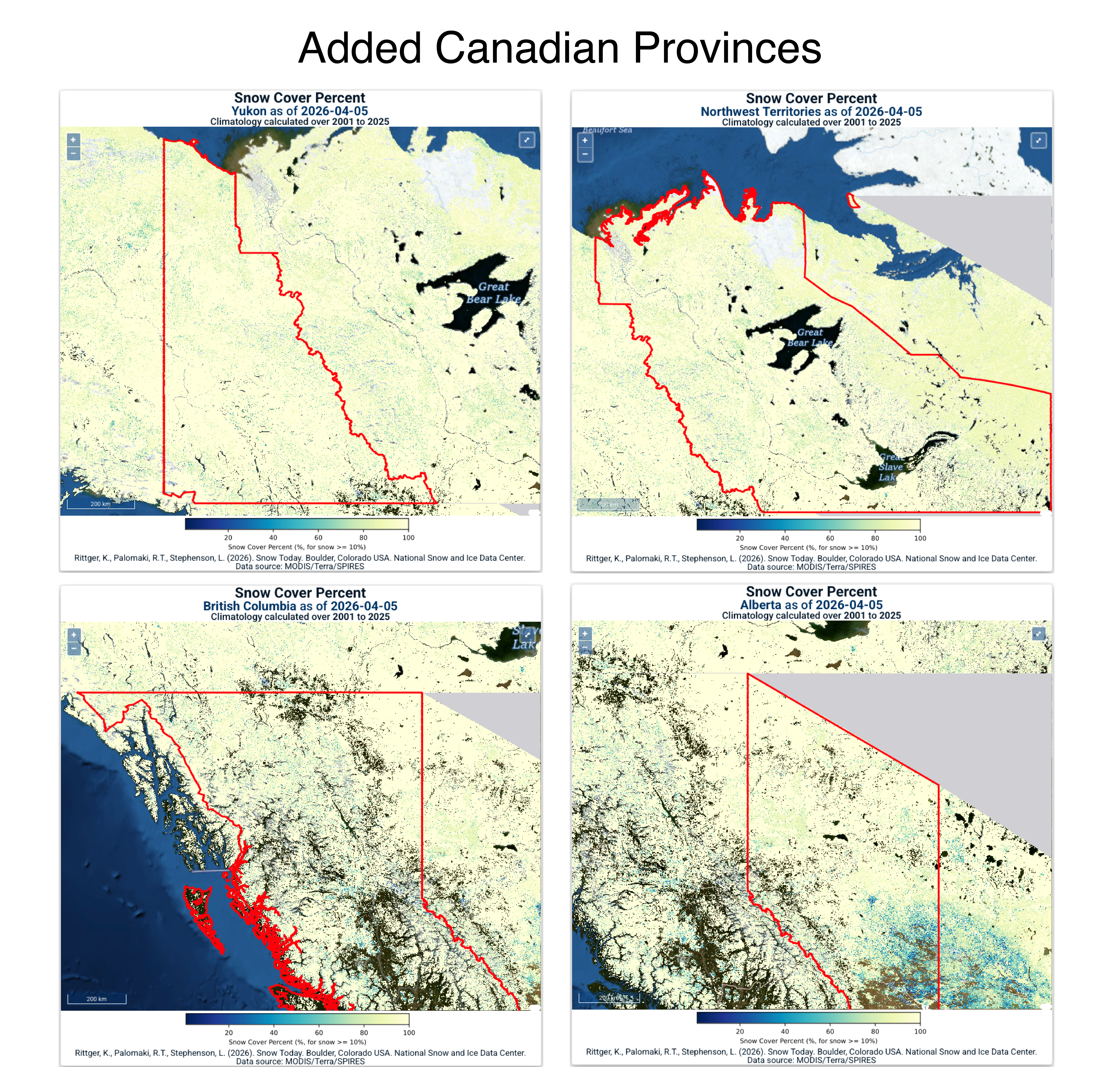
Figure 1a: The state of Alaska has been added to Snow Today. — Credit: Ross Palomaki, Logan Stephenson, and Karl Rittger, Institute of Arctic and Alpine Research
Figure 1b: The Canadian provinces of Yukon, Northwest Territories, British Columbia, and Alberta have also been added to Snow Today. —Credit: Ross Palomaki, Logan Stephenson, and Karl Rittger, Institute of Arctic and Alpine Research
Overview of conditions
Snow-covered area in March averaged across the western United States was 34 percent of average, at 209,000 square kilometers (81,000 square miles) of snow cover, ranking last in the 26-year satellite record (Table 1). Snow-covered area for March was 1,037,000 square kilometers (400,000 square miles) below 2023, the highest year, and 122,000 square kilometers (47,000 square miles) below 2015, the second lowest March on record.
Table 1. March 2026 Snow Cover in the Western United States (Relative to the 26-Year Satellite Record)
| Snow-Covered Area | Square Kilometers | Square Miles | Rank |
|---|---|---|---|
| March 2026, Lowest | 209,000 | 81,000 | 26 |
2001 to 2025, Average | 614,000 | 237,000 | -- |
2023, Highest | 1,246,000 | 481,000 | 1 |
2025, Previous year | 475,000 | 183,000 | 21 |
2015, Previous lowest | 331,000 | 128,000 | 25 |
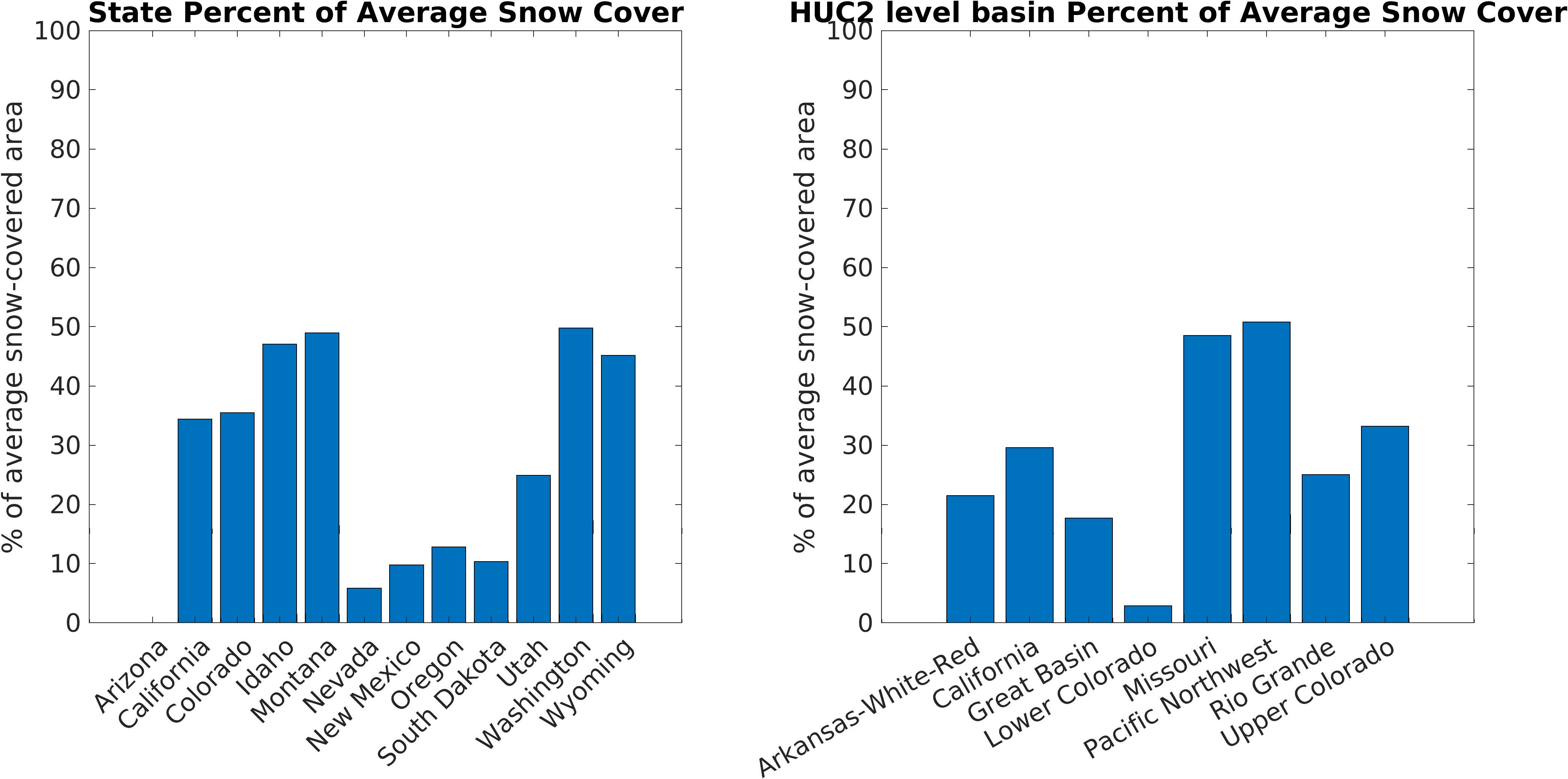
Snow cover was far below average in all western US states in March (Figure 2, left). Washington, at 50 percent of average, had the greatest snow cover for the month, followed by Montana at 49 percent, Idaho at 47 percent, and Wyoming at 45 percent. Snow cover in both California and Colorado was roughly one-third of average. Oregon was 13 percent of average, New Mexico 10 percent, South Dakota 10 percent, and Nevada 6 percent. Arizona had almost no snow.
All HUC2 basins in the western US also suffered from snow drought (Figure 2, right). Snow cover percent was only 33 percent of average in the Upper Colorado, 30 percent in the California basin, and 25 percent in the Rio Grande. The Arkansas-White-Red (21 percent of average) and Great Basin (18 percent of average) both had only one-fifth of average snow cover. Almost no snow was present in the Lower Colorado basin during March with only 3 percent of average snow cover. The Pacific Northwest (51 percent of average) and Missouri (49 percent of average) basins, which both extend into southern Canada, recorded the greatest snow cover relative to average.
Conditions in context: Snow cover
Following widespread snowstorms in late February, snow-covered area steadily declined during March (Figure 3, upper left). By the end of March, snow-covered area was 63 percent of average. Only Colorado and Montana had significant snowfall during March, but this snow quickly melted.
Averaged across the month, almost the entire western US recorded far below average snow cover compared to the 26-year satellite record (Figure 3, upper right). Snow cover was 80 to 100 percent below average in large areas of Colorado, Utah, Idaho, Nevada, Oregon, and California. Some small areas of central Montana, Idaho, and northern Washington had above average snow cover, but the rest of the West was extremely dry. The Midwest fared better, with 20 to 60 percent above average snow cover observed in parts of North and South Dakota and Minnesota.

Snow cover duration, measured in days summed from October 1, 2025, to March 31, 2026, increased throughout March but remained roughly 35 percent of average (Figure 3, bottom left). In large parts of Colorado, Wyoming, Idaho, Utah, Nevada, and Oregon, snow cover duration was 80 to 100 days below average. Snow cover duration in all other western US states was also far below average. Only limited low elevation areas of California’s Sierra Nevada and parts of northern Washington and central Idaho had an above average number of snow-covered days.
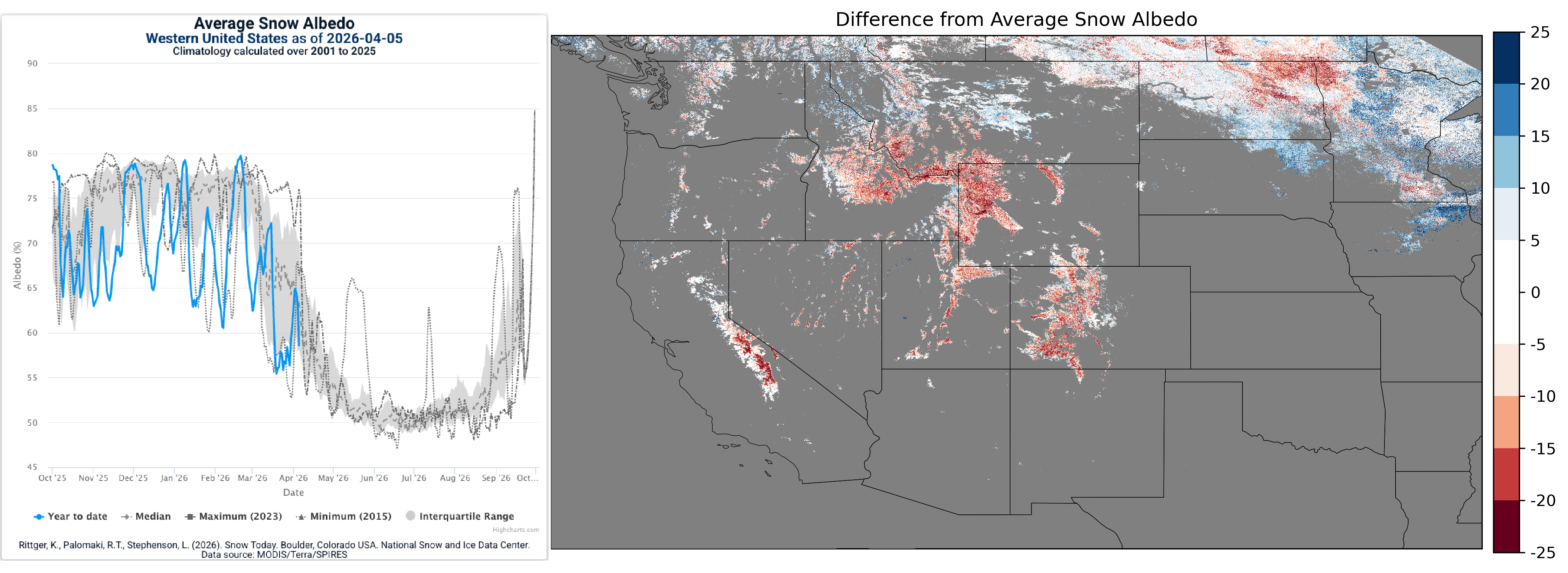
In contrast to snow-covered area and duration, average snow brightness, known as snow albedo, varied throughout the month (Figure 4, left). On March 1, albedo was 82 percent of average before increasing to 110 percent of average on March 15 from snowstorms in Montana and the Missouri river basin. By March 19, average albedo had decreased from 72 to 55 percent and remained below average for the rest of the month.
Albedo also varied significantly by state, elevation, and latitude during March (Figure 4, right). Most notably, high elevation areas in California, Colorado, and Utah had far below average albedo (15 to 25 percent below average) and close to or above average albedo at lower elevations. High temperatures following snowfall quickly melted snow before it could darken, resulting in above average albedo at low elevations in California. Albedo was also low in Wyoming, central Idaho, and southern Montana. Albedo was higher moving north into Idaho and Montana, as well as northern Washington.
Conditions in context: Snow water equivalent (SWE)
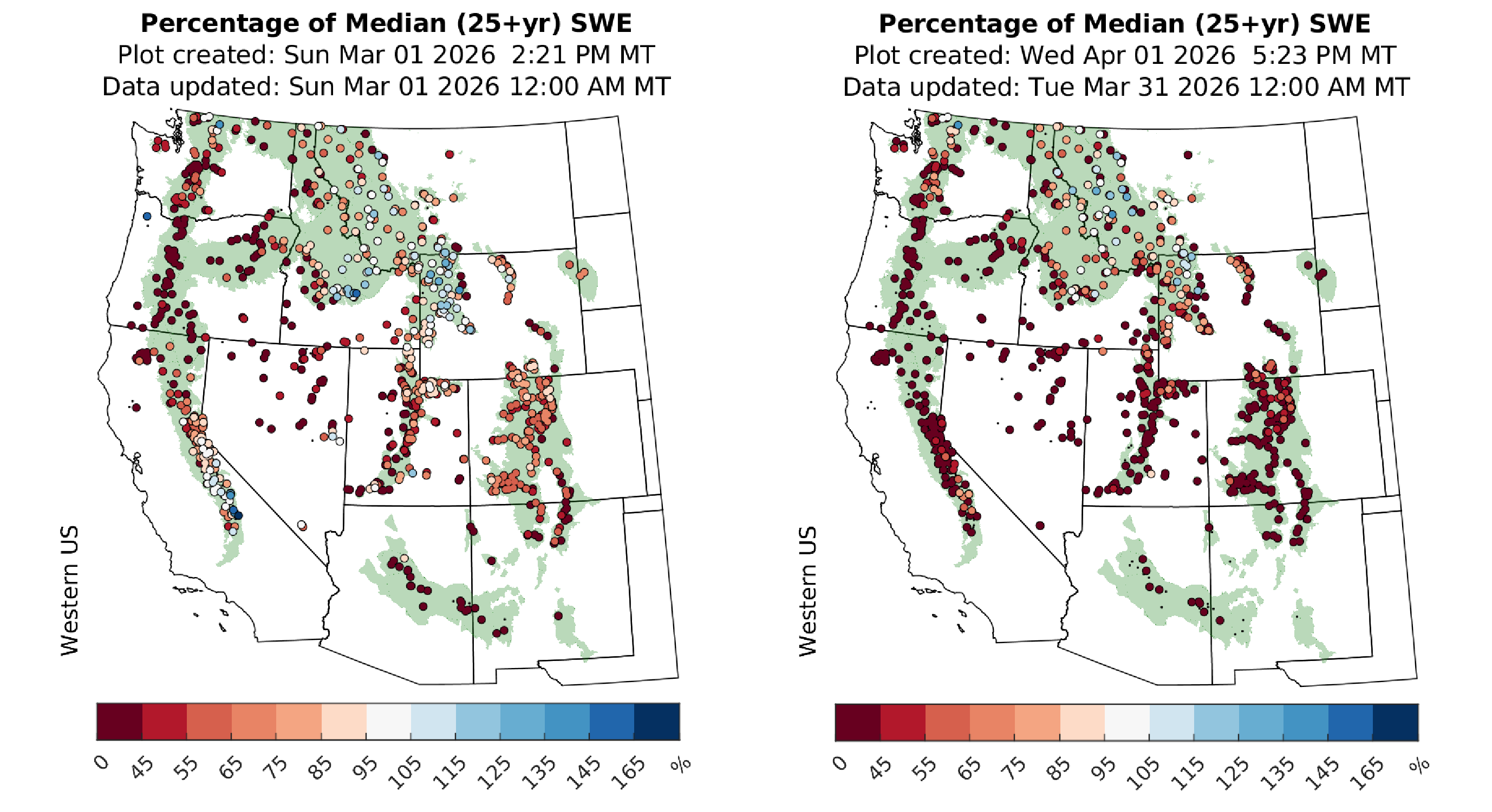
Snow water equivalent (SWE) varied across western US states at the beginning of March with a significant number of sites having modestly above-average values (5 to 15 percent) in California, Wyoming, Idaho, Montana, and northern Washington (Figure 5, left). SWE was well below average in all other western US states, particularly in Oregon, Nevada, Arizona, New Mexico, and Colorado. By the end of the month, both by magnitude and number of sites, SWE values had dropped dramatically (Figure 5, right). On March 31, no sites in California, Oregon, Nevada, Utah, Arizona, New Mexico, or Colorado recorded above average SWE and most were between 0 and 45 percent of average. Wyoming and Idaho also had fewer sites with above average SWE by the end of the month. Only Montana maintained roughly average SWE.
From March 1 to March 31, SWE increased at most northern stations, and decreased elsewhere (Figure 6, left). Most sites in Washington, Montana, and northern Idaho saw net increases in SWE during the month with many gaining more than 8 centimeters (3 inches) of SWE. Some sites in these states gained over 30 centimeters (12 inches) of SWE (Figure 6, right). A small number of sites in Colorado, Wyoming, and Oregon had net gains in SWE. SWE in California decreased the most drastically during the month, with an average net loss of 20 centimeters (8 inches) across the state. Many sites lost over 30 centimeters (12 inches) of SWE, and some lost close to 60 centimeters (24 inches). Only Washington and Montana had gains in SWE during the month.