
By Michon Scott
The Arctic Report Card, supported by the National Oceanic and Atmospheric Administration (NOAA), is an annual, peer-reviewed snapshot of environmental conditions north of 60°N. Topics range from air temperature to land and sea ice to changes in marine algae to marine debris left by ship traffic to community monitoring programs.
As far away as the Arctic may seem, it directly affects the United States. “The United States is an Arctic country,” NSIDC Distributed Active Archive Center (DAAC) scientist Walt Meier said. “Alaska is a part of the Arctic. It is strategically important for national security, for commerce, and there are residents, US citizens, who live in the Arctic.”
In the early 2000s, scientists recognized the need for a comprehensive Arctic assessment. The Arctic Council—an international group of Arctic states and Indigenous peoples—commissioned the Arctic Climate Impact Assessment. The assessment was published in 2004, with contributions from hundreds of researchers worldwide. However, the report took years to produce. As Arctic change accelerated, scientists needed to supplement such resource-intensive assessments with more frequent updates. This led to the Arctic Report Card: an annual report designed to balance scientific rigor with timeliness and accessibility.
NOAA issued the first annual Arctic Report Card in 2006. Arctic Report Card 2025, published this past December, is the twentieth edition of the annual report. Since its inception, the Arctic Report Card has relied upon NSIDC scientists as authors and/or editors nearly every year, and incorporated NSIDC data in every single issue. NSIDC’s science and data expertise has been integral to monitoring Earth’s dynamic northernmost latitudes.

A fast-changing, relevant region
The Arctic has a substantial impact on people living at lower latitudes. “A good analogy for the Arctic is that it’s like an air conditioning or water supply system in your office or home. You might not pay that much attention to it, but it’s providing really important services in keeping you cool or keeping you watered,” said NSIDC deputy lead scientist Twila Moon. Snow and ice in the Arctic reflect solar radiation back into space, helping regulate global temperatures. Arctic glaciers and the Greenland Ice Sheet also store vast amounts of water that would otherwise raise global sea levels.
To assume that the services the Arctic provides will continue unabated would be a mistake, given how rapidly the region is changing. Scientists call this accelerated warming “Arctic amplification.” As the planet warms, the Arctic warms even faster. Multiple factors drive this amplification, including the transport of warm air from the tropics, and the loss of sunlight-reflecting snow and ice across the Arctic. As the Arctic Report Card authors reported in December 2025, the Arctic is quickly changing:
- Arctic temperatures have risen nearly three times faster than the global average over the past 20 years.
- June snow cover is about half what it was in the late 1960s.
- Thick sea ice more than four years old has declined by over 95 percent since the 1980s.
As temperatures rise, Arctic wildlife struggles:
- Animals adapted to snowy environments lose their camouflage.
- Polar bears and seals struggle as sea ice disappears.
- Beavers reshape tundra ecosystems by damming waterways.
Human impacts are just as significant:
- Subsistence hunting and fishing become more difficult.
- Coastal erosion threatens homes.
- The region becomes more accessible for shipping and resource extraction.
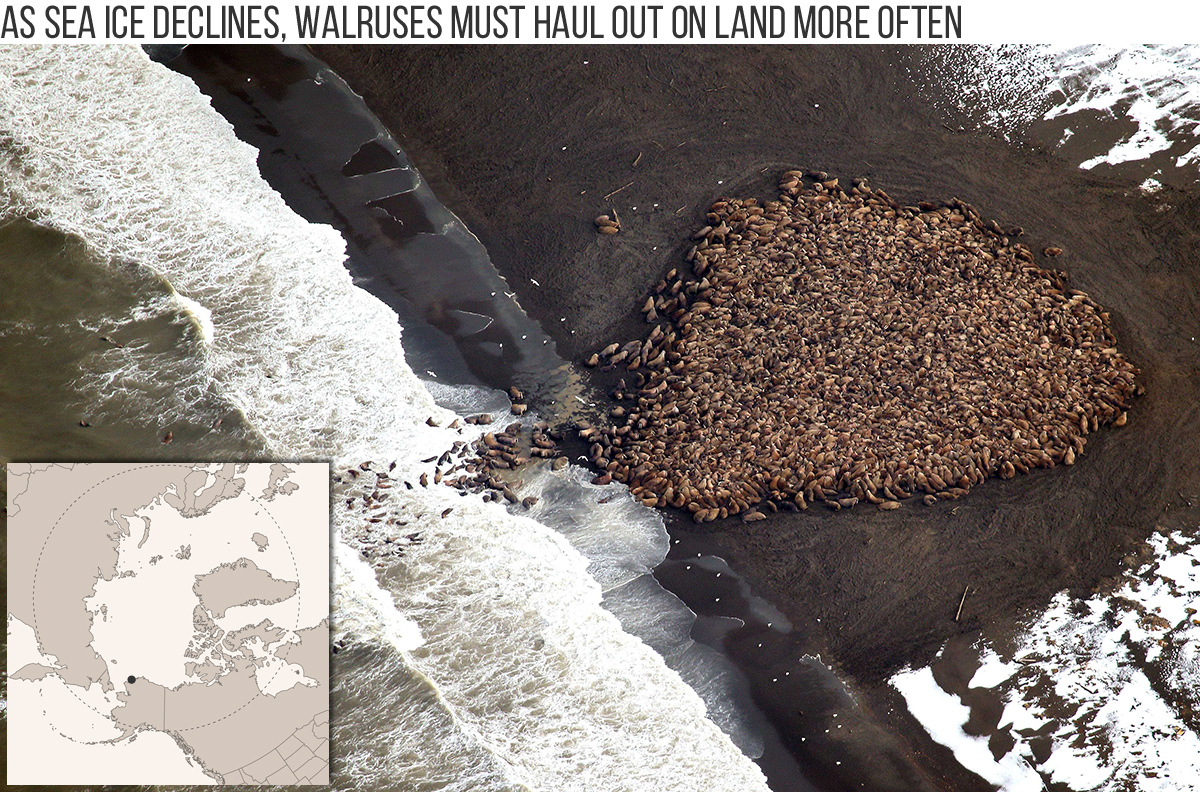
To track these changes, every Arctic Report Card now devotes a chapter to each of the following:
- Surface air temperature
- Precipitation
- Terrestrial snow cover
- The Greenland Ice Sheet
- Sea ice
- Sea surface temperature
- Arctic ocean primary productivity (how marine algae respond to changing conditions)
- Tundra greenness

In addition to the chapters that appear every year, each Arctic Report Card highlights emerging issues such as glacier changes, ecosystem shifts, and notable environmental events. Each report spans the “water year” (October 1 through September 30) capturing the full cycle from winter freeze to summer melt. The water year also works well for reporting Arctic wintertime conditions since it avoids splitting the Northern Hemisphere winter into separate reports.
NSIDC’s support for monitoring
NSIDC has played a key role in Arctic reporting for decades. NSIDC founding director Roger Barry and current NSIDC director Mark Serreze both contributed to the Arctic Climate Impact Assessment published in 2004. Serreze contributed to the Arctic Report Card for years afterward, including the 2025 report. “Once I became involved, I realized this is a good thing because I can use my expertise, and the report is a good service to the community,” he said.
Since NOAA began issuing annual Arctic Report Cards, Serreze and multiple other NSIDC scientists have contributed, among them Richard Armstrong, Matthew Druckenmiller, Noor Johnson, Walt Meier, Twila Moon, and Julienne Stroeve. Druckenmiller and Moon have served as report editors in recent years.
NSIDC data have been cited in every issue of the Arctic Report Card since its inception, supporting both analysis and long-term climate records. Report authors have relied upon data sets from both the NSIDC Distributed Active Archive Center (DAAC) and the NSIDC National Oceanic and Atmospheric Administration program (NOAA@NSIDC). Key NSIDC-supported data used in the report include:
- Sea Ice Index
- Sea Ice Today
- AMSR2 sea ice concentration data
- Ice Sheets Today
- ICESat-2 land ice measurements
- Permafrost monitoring data sets
The earliest Arctic Report Cards incorporated sea ice data sets distributed by NSIDC, and this naturally led to NSIDC’s involvement in authoring the report. “Because NSIDC has the sea ice data, [early report editors] thought it appropriate to have someone in the NSIDC provide that,” Meier said.
How the report card comes together
The Arctic Report Card follows a structured annual process:
- January: Planning begins and topics are identified
- May and June: Authors are recruited
- July: Editors and authors hold a kickoff meeting
- September: Draft chapters are submitted
- October: Peer review is coordinated by the Arctic Monitoring and Assessment Programme (AMAP)
- November: Authors revise chapters
- December: The report is released at the American Geophysical Union annual meeting
Despite the tight timeline, the report maintains rigorous scientific standards while delivering timely insights.
The Arctic Report Card has three editors, but among those, there is always a lead editor who, among other duties, unveils the report at the press conference. “We rotate through who acts as lead editor each year,” Moon explained. “The wonderful thing about having our multiple-editor team is that we all have different strengths, and certainly, the sum is greater than its parts in very positive ways.” Though one editor rotates through the lead position each year, they collaborate, for instance on summary articles in The Conversation, or in reaching out to Congress. In January 2026, Druckenmiller and Moon participated in four closed-door Senate briefings.

A sound investment in the future
As the Arctic becomes more central to global climate, economics, and geopolitics, the need for timely, trusted information continues to grow. Serreze said, “The Arctic is on the forefront of climate change, not just in terms of the physical changes, but also how it is all getting tied into politics and economics and geopolitics.”
The region’s rapid pace of change and the growing political interest both reinforce the need for timeliness, and timeliness sets the Arctic Report Card apart from some other documents. For instance, every year, the Bulletin of the American Meteorological Society (BAMS) publishes its State of the Climate (SotC) report for the previous year. An international team of experts puts together the annual, peer-reviewed report spanning all aspects of Earth’s climate and running to several hundred pages. These reports are comprehensive but often delayed, making timely updates like the Arctic Report Card especially valuable.
“Something that's unique about the Arctic Report Card is that it comes out every year, broadly at the end of the year that is being discussed,” Moon said. “There are a lot of groups that rely on it as that early prompt, dependable, and peer-reviewed resource.” Moon also emphasized the report’s accessibility. “It’s important to us that the pieces are relatively succinct, and we work hard to make them understandable to the non-specialist.” Moon continued, “It's about having an Arctic-aware citizenry and an Arctic-aware and prepared workforce.”
Part of that effort for maximal usability is the new feature that came online with the 2025 report card edition: the Arctic Report Card Data Dashboard. The dashboard allows users to explore Arctic data interactively through a web browser.

Along with their pride in what the Arctic Report Card has already provided, NSIDC contributors to the annual report hope for future enhancements. NSIDC contributors all share a desire to expand the report’s offerings, so that features that currently run every few years, such as glacier changes, might feature more often. Authors also hope to improve cross-links between report chapters, for instance, between surface air temperatures, sea ice extent, and ocean primary productivity. “We do have cross-referencing now,” Meier explained, “but the report chapters are maybe not as integrated as they could be. It is difficult to do on such a short timeline.”
Still, many of the hopes for the future are largely to stay the course. “Continuing to keep this truly an international report, in terms of the topics covered, the contributing authors, and the dissemination of the report,” Druckenmiller remarked, touching upon a desire for better reach in Europe. He also hopes congressional outreach continues.
The Arctic may feel distant, but its impacts are increasingly close to home. The Arctic Report Card helps make those connections clear, translating complex science into insight people can act on. As Moon described, its mission is “continuing to help people understand why we care about the Arctic, and how those impacts are making it to their doorstep, both within the Arctic and far from it.”