
Arctic Rain On Snow Study (AROSS)
Book
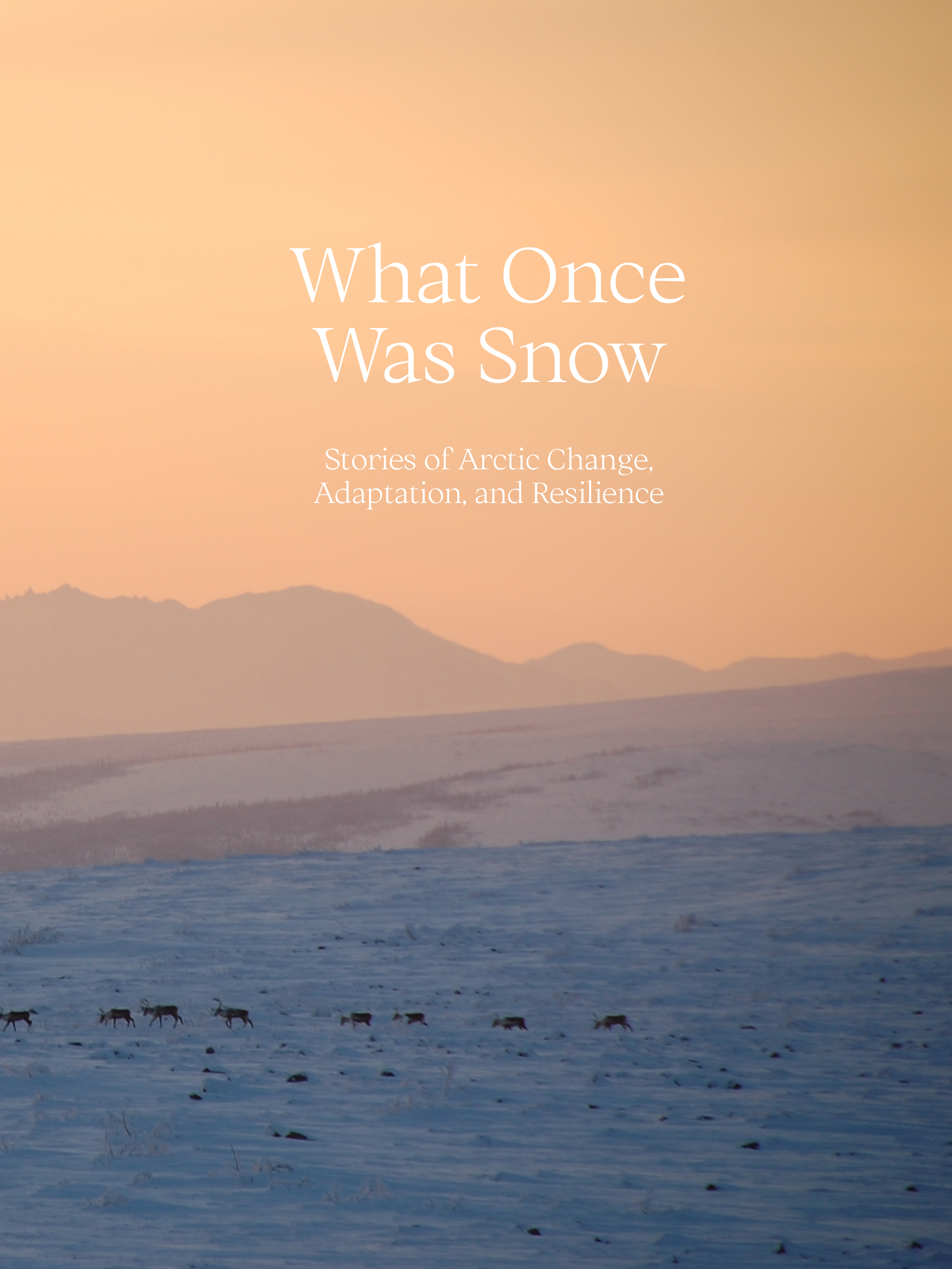
What Once Was Snow: Stories of Change, Adaptation, and Resilience in the Arctic is an exploration of what it means to live in a world where one of the Arctic’s most defining features—snow—is becoming more unpredictable. Blending storytelling with science and Indigenous Knowledge, the book chronicles the changing rhythms of Arctic life amid a warming climate, revealing both its vulnerability and resilience.
For centuries, snow has been the Arctic’s timekeeper, marking the cadence of life, migrations, and seasonal shifts. Its accumulation provides insulation for plants and animals, safe passage for travelers, and water during the spring thaw. Indigenous peoples have built languages, livelihoods, and worldviews in relationship with the annual cycle of the snow cover. But as the Arctic warms more than four times faster than the global average, rain-on-snow events disrupt ecosystems, isolate communities, and test the deep environmental knowledge of those who know the land best.
Through a series of interconnected stories, What Once Was Snow introduces readers to herders, scientists, and families across the Arctic. Each chapter offers a grounded perspective on adaptation and survival in the face of environmental transformation. The book opens on Russia’s Yamal Peninsula, where a devastating 2013 rain-on-snow event trapped pastures under ice, killing thousands of reindeer and threatening the Nenets people’s nomadic way of life. From there, readers travel through Finland’s herding communities, Greenland’s sheep-farming settlements, and Alaska’s reindeer herding families, each contending with new hazards, uncertain futures, and the need for creative adaptations.
The book explores atmospheric and oceanic processes that drive these changes, explaining why Arctic amplification causes extreme weather patterns and unpredictable snow seasons. Interwoven throughout are reflections on language, knowledge, and observation: how the Nenets language encodes the subtle textures of snow; how Indigenous and community-based networks document local impacts; and how the co-production of knowledge between scientists and Indigenous experts can illuminate complex systems beyond the reach of any single discipline.
Guided by the Arctic Rain on Snow Study (AROSS)—a multinational collaboration among institutions in the United States, Canada, and Finland—What Once Was Snow captures a pivotal moment in Earth’s history. It presents not only the biophysical dimensions of a rapidly changing Arctic but also the cultural, economic, and inter-generational implications of these transformations. The stories illustrate how the loss of predictable snow conditions ripples outward, affecting food security, transportation, animal welfare, and the cultural continuity of Arctic peoples.
Data Citation