Quick Facts on Arctic Sea Ice
Sea ice can take on a variety of textures. When waves buffet the freezing ocean surface, characteristic "pancake" sea ice forms. This sea ice was photographed near Antarctica. —Credit: Ted Scambos, NSIDC
What is sea ice?
Sea ice is frozen ocean water. It forms, grows, and melts in the ocean. In contrast, icebergs, glaciers, and ice shelves float in the ocean but originate on land. For most of the year, sea ice is typically covered with snow.
Why is Arctic sea ice important?
Arctic sea ice keeps the polar regions cool and helps moderate global climate. Sea ice has a bright surface; 80 percent of the sunlight that strikes it is reflected back into space. As sea ice melts in the summer, it exposes the dark ocean surface. Instead of reflecting 80 percent of the sunlight, the ocean absorbs 90 percent of the sunlight. The oceans heat up, and Arctic temperatures rise further.
A small temperature increase at the poles leads to still greater warming over time, making the poles the most sensitive regions to climate change on Earth. According to scientific measurements, both the thickness and extent of summer sea ice in the Arctic have shown a dramatic decline over the past thirty years. This is consisistent with observations of a warming Arctic. The loss of sea ice also has the potential to accelerate global warming trends and to change climate patterns.
For more on the ways sea ice interacts with other Earth systems, including global ocean circulation, people, and animals, see All About Sea Ice: Environment.
The 2007 Arctic sea ice minimum, on September 16, 2007, reached the lowest ice extent in the satellite record. —Credit: National Snow and Ice Data Center
What is sea ice extent, and why do you monitor that particular aspect of sea ice?
Sea ice extent is a measurement of the area of ocean
where there is at least some sea ice. Usually, scientists define a
threshold of minimum concentration to mark the ice edge; the
most common cutoff is at 15 percent. Scientists use the 15
percent cutoff because it provides the most consistent agreement between
satellite and ground observations.
Scientists tend to focus on Arctic sea ice extent more closely than
other aspects of sea ice because satellites measure extent more accurately
than they do other measurements, such as thickness. For more on sea ice extent, see Frequently Asked Questions About Arctic Sea Ice: "What is the difference between sea ice area and extent?"
What is the Arctic sea ice minimum?
The Arctic sea ice minimum marks the day, each year, when the sea
ice extent is at its lowest. The sea ice minimum occurs at the end
of the summer melting season.
The summer melt
season usually begins in March and ends sometime during September.
The sea ice
minimum has been occurring later in recent years because of a longer
melting season. However, ice growth and
melt are local processes; sea ice in some areas will have already
started growing before the date of the sea ice minimum, and ice in
other areas will still shrink even after the date of the minimum.
Changes in the timing of the sea ice minimum extent are especially
important because more of the sun's energy reaches Earth's surface
during the Arctic summer than during the Arctic winter. As explained
above, sea ice reflects much of the sun's radiation back into space,
whereas dark, ice-free ocean water absorbs more of the sun's energy.
So, reduced sea ice during the sunnier summer months has a big
impact on the Arctic's overall energy balance.
For
more information on current sea ice conditions see the Arctic Sea Ice News & Analysis Web page. To read NSIDC press releases on past Arctic sea ice minima, see the Arctic Sea Ice Press Announcements Archive on the Arctic Sea Ice News & Analysis Web page.
Seen from January through December, this timeseries shows the natural waxing and waning of the Arctic sea ice cover with the seasons. The maximum extent generally occurs in March, the minimum extent in September. Sea ice extent in 2008 (purple) fell well below the 1979 to 2000 long-term average (gray) and was very slightly above 2007 (dotted light green), in which the lowest summer minimum and the second-lowest winter maximum occurred.
—Credit: NSIDC
What is the Arctic sea ice maximum?
The Arctic sea ice maximum marks the day of the year when Arctic sea
ice reaches its largest extent. The sea ice maximum occurs
at the end of the winter cold season.
The Arctic cold season usually begins in September and ends in March.
Monitoring winter sea ice is important to understanding the state
of the sea ice. Scientists have found that Arctic sea ice has been
recovering less in the winter, meaning the sea ice is already "weak" when
the summer melting season arrives. A possible cause is that the underlying
ocean is warmer.
To read NSIDC press releases on past Arctic sea ice maxima, see the Arctic Sea Ice Press Announcements Archive on the Arctic Sea Ice News & Analysis Web page
How do scientists monitor the Arctic sea ice?
Obtaining reliable measurements of sea ice as it changes was difficult
until the satellite era began in the early 1970s. To monitor
Arctic sea ice, NSIDC primarily uses the NASA Advanced Microwave Scanning Radiometer–Earth Observing System (AMSR-E) instrument on the NASA
Terra satellite and the Special Sensor Microwave/Imager (SSM/I) instrument
on the Defense Meteorological Satellite Program (DMSP) satellite. The
satellites pass over the polar region several times each day to gather
data; researchers can then form the data into images for analysis and publication.
Useful satellite data concerning sea ice began in late 1978 with the
launch of NASA’s Scanning Multichannel Microwave Radiometer (SMMR) satellite.
When scientists compare average sea ice conditions between years, they
often use a reference period of 1979 to 2000.
This reference period allows a consistent comparison of changes in
extent over individual years. Scientists generally do not include data
from 2000 forward because that period has seen especially sharp declines
in sea ice extent.
To learn more about studying sea ice, see All
About Sea Ice: Studying; to explore the satellite-derived sea ice images, see
the Sea Ice Index.
Is Antarctic sea ice important, too? Is it shrinking?
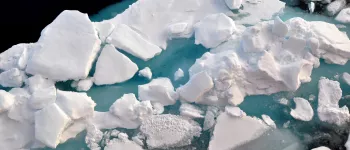
Strong winds caused sea ice to crack and buckle off the coast of Greenland.
—Credit: Andy Mahoney, NSIDC
Scientists monitor both Arctic and Antarctic sea ice, but Arctic sea
ice is more significant to understanding global climate because
much more Arctic ice remains through the summer months, reflecting
sunlight and cooling the planet.
Sea ice near the Antarctic Peninsula, south of the tip
of South America, has recently experienced a significant decline.
The rest of Antarctica has experienced a small
increase in Antarctic sea ice.
Antarctica and the Arctic are reacting differently to climate change partly because of geographical differences. Antarctica is a continent surrounded by water, while the Arctic is an ocean surrounded by land. Wind and ocean currents around Antarctica isolate the continent from global weather patterns, keeping it cold. In contrast, the Arctic Ocean is intimately linked with the climate systems around it, making it more sensitive to changes in climate.
For more information about Antarctic
sea ice, see All
About Sea Ice: Arctic vs. Antarctic. Also read Frequently Asked Questions About Arctic Sea Ice:" Why don't I hear much about Antarctic sea ice?"
Where can I learn more?
NSIDC Resources
Arctic Sea Ice News & Analysis. Follow current sea ice conditions with monthly updates and analysis.
Frequently Asked Questions about Arctic Sea Ice. Read scientist answers to common questions regarding Arctic sea ice.
All About Sea Ice. This educational site covers many aspects of sea ice.
State of the Cryosphere: Sea Ice. Learn how sea ice has changed in recent years.
NSIDC Data
NSIDC distributes scientific data sets related to sea ice. See Sea Ice Products at NSIDC to learn more about our data holdings.